
Mental models shape how users interact with your product, often without them even realizing it. When users open your app or visit your website, they don’t arrive as blank slates ready to learn your system. Actually, they bring expectations based on past experiences that influence how they think your product should work.
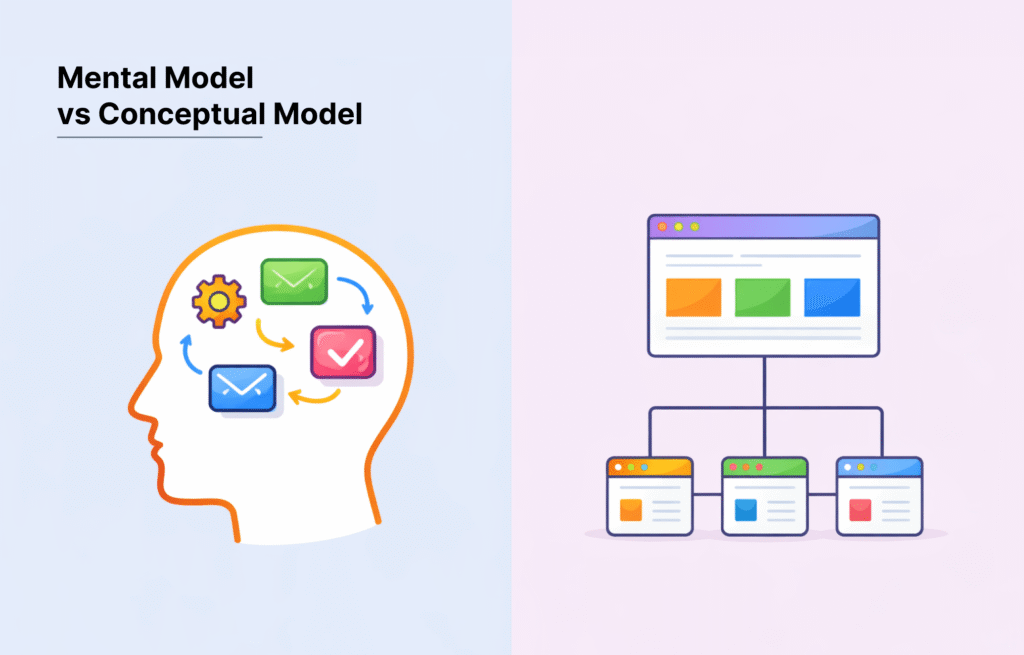
What is a mental model in UX design? It’s what users believe about your product based primarily on their previous interactions with similar systems. When there’s a mismatch between what users expect and how your product actually behaves, confusion happens. This is why what we often label as “user error” is typically the result of poorly aligned expectations and reality. In successful UX design, understanding how users think is far more valuable than guessing what they want.
We’ve found that good user experiences happen when product design aligns with users’ mental models. However, designers often make the critical mistake of designing based on their own mental models rather than the users’, creating a disconnect that frustrates people trying to use the product. Throughout this article, we’ll explore how to bridge this gap and create interfaces that feel natural and intuitive to your users.
What is a mental model in UX design?
A mental model exists inside your users’ minds before they ever touch your product. In the simplest terms, a mental model represents what users believe about how your system works. These invisible frameworks powerfully guide every interaction people have with your interface.
How mental models shape user expectations?
Mental models aren’t just abstract concepts—they’re practical tools users employ every day. Essentially, your users approach new products with assumptions built from similar experiences.
→ Users predict system behavior based on their mental models
→ People plan actions according to these predictions
→ First impressions determine whether users stay or leave
For example, someone familiar with weather apps expects temperature information in specific locations and forecast data in familiar formats. The success of your interface depends largely on how well it aligns with these expectations.
Why users rely on past experiences?
Users don’t arrive at your product as blank slates. Furthermore, they bring their entire digital history with them. According to Jakob’s Law, people spend most of their time on websites other than yours, which means their expectations are heavily influenced by previous online experiences.
Consider how frustrating it feels when a familiar action produces unexpected results. This happens because our brains create shortcuts based on past interactions, allowing us to navigate interfaces more efficiently—but only if our mental models match reality.
The difference between user and designer mental models
One of the biggest challenges in UX design stems from the gap between designer and user mental models. As designers, we understand our systems intimately, we know why every feature exists and how everything connects together.
Meanwhile, users have incomplete, sometimes inaccurate understandings of how our products work. This mismatch explains why features obvious to designers often confuse users. What seems intuitive to you might be completely foreign to someone using your product for the first time.
In addition, designers must remember they aren’t designing for themselves but for people with different backgrounds, experiences, and mental frameworks. Bridging this gap requires empathy and research—not assumptions.
Users expect familiar patterns, not new learning curves
“Users spend most of their time on websites other than yours.” — Jakob Nielsen, Co-founder of Nielsen Norman Group, pioneer in usability research and UX design
When you design a new digital product, there’s a crucial fact I’ve learned: **users don’t want to learn your system** – they expect it to match what they already know. This expectation forms the foundation of user experience design that respects mental models.
The cost of forcing users to learn your system
Every innovation that departs from established patterns forces users to climb a learning curve. This creates several problems:
→ Increased cognitive load as users must relearn interactions
→ Mental fatigue and frustration when expectations aren’t met
→ Higher error rates as users struggle with unfamiliar patterns
→ Reduced engagement and retention as users abandon difficult products
The science behind this is simple – our brains crave predictability and efficiency. We process familiar interfaces faster and with less mental effort. On the contrary, when confronted with unfamiliar patterns, users must shift their attention from their goal to figuring out how your interface works.
Real-world examples of mental model mismatches
I’ve seen countless examples where mental model mismatches create frustration:
Microsoft Word’s transition from its 2010 to 2013 version included major layout changes that left many users disoriented. Similarly, when online stores like Nomad Lane automatically add shipping insurance at checkout without clear opt-out options, they violate users’ shopping cart mental model, causing confusion.
Another common problem occurs with multiple search features on the same page. Users often enter queries in the wrong box, assuming the site doesn’t have what they need when nothing returns.
Why consistency matters more than innovation?
Although innovation drives progress, consistency builds trust. When users encounter consistent design patterns, they effortlessly transfer knowledge from one part of your application to another.
Consistency matters primarily because:
→ Users feel comfortable and in control
→ Navigation becomes intuitive instead of confusing
→ Trust in your product increases
→ Users spend less time thinking and more time doing
In essence, while consistency might seem limiting, it actually liberates users from the burden of constant learning, allowing them to focus on their goals instead of your interface.
How to align your product with user mental models?
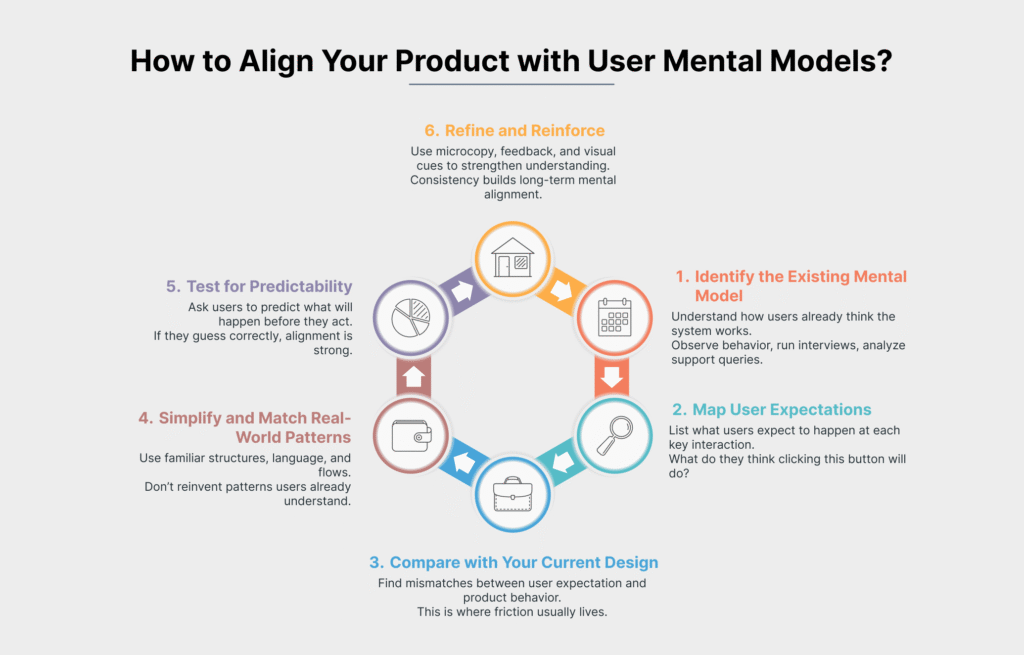
Designing products that match user mental models requires intentional research and thoughtful implementation. The goal is creating interfaces that feel familiar at first glance.
Research methods to understand user expectations
Discovering what users truly expect begins with observation. Interviews and direct observation are the most effective ways to uncover mental models. Watch users complete tasks firstly, afterward ask them to explain their thinking.
→ Create mental model maps to document user thought processes
→ Run usability tests with think-aloud protocols
→ Observe users interacting with existing systems
Using familiar UI patterns and conventions
Jakob’s Law reminds us that users spend more time on other sites than yours. Consequently, incorporate design elements people already recognize:
→ Research popular platforms in your industry
→ Adopt standard navigation patterns people understand
→ Avoid unnecessary innovation that confuses users
Creating intuitive interfaces through recognizable elements
Good design goes unnoticed. Create familiarity through:
→ Consistent patterns throughout your product
→ Visual organization that keeps related elements together
→ Clean grid systems that establish order and balance
When and how to challenge existing mental models?
Sometimes innovation requires breaking established patterns. Nevertheless, help users adapt by:
→ Providing clear instructions and visual cues
→ Including onboarding guides or tooltips
→ Testing thoroughly before full implementation
Above all, remember that altering design to match users’ mental models typically works best. This eliminates the need for users to overcome inertia while creating a more seamless experience.
Common mistakes designers make with mental models
“We must design for the way people behave, not for how we would wish them to behave.” — Don Norman, Cognitive scientist, author of ‘The Design of Everyday Things’, design thought leader
The biggest risk in design isn’t technical limitations but the blind spots in how we think. Despite our best intentions, designers repeatedly fall into the same mental model traps that frustrate users and derail experiences.
Designing based on your own assumptions
Designers develop detailed mental models of their own creations, making them believe every feature seems obvious. Unfortunately, this creates a dangerous illusion—what makes perfect sense to you often confuses your users. The problem stems from designers assuming users will approach problems the same way.
→ Assuming everyone shares your technical expertise
→ Testing with leading questions (“Was that easy to find?”)
→ Substituting your judgment for actual user research
Ignoring industry-standard patterns
There’s tremendous inertia in users’ mental models—what people know well tends to stick. Yet designers sometimes ignore established patterns in pursuit of uniqueness.
→ Reinventing navigation just to be different
→ Creating custom UI when standard components work better
→ Discarding conventions that users already understand
One designer admitted: “We avoided industry-standard UI to be unique. Now I regret it”. Remember, users don’t want “unique”—unique is weird. What users want is “better”.
Overcomplicating simple interactions
Our urge to innovate sometimes leads to unnecessary complexity. A developer described spending three hours making a simple change buried under multiple design patterns.
→ Adding too many options and features
→ Creating multi-step processes for simple tasks
→ Forcing users to navigate elaborate abstractions
Ultimately, the key is balance. Mental models work best when they match user expectations without unnecessary complexity.
Conclusion
Understanding mental models fundamentally changes how we approach product design. Users don’t want to learn your product from scratch – they expect it to work according to what they already know. Therefore, successful design happens when we bridge the gap between user expectations and product reality.
Designers must remember this crucial fact: what seems intuitive to you might be completely foreign to your users. Additionally, forcing people to learn unfamiliar patterns creates frustration, increases cognitive load, and ultimately drives them away from your product.
What matters most? Meeting users where they are. This means:
🔹 Researching how users actually think about your product
🔹 Using familiar patterns they already understand
🔹 Creating consistency across your interface
🔹 Challenging existing models only when absolutely necessary
The best products feel invisible because they match how users expect them to work. Consequently, users spend less time figuring out interfaces and more time accomplishing their goals.
Though innovation drives progress, user comfort builds trust. We must design for actual human behavior rather than ideal scenarios. After all, the ultimate measure of good UX isn’t how clever or unique your design is – but how effortlessly users can achieve their goals without thinking about your interface at all.
Key Takeaways
Users approach your product with pre-existing mental models based on their past digital experiences, not as blank slates ready to learn new systems.
• Match user expectations, don’t force learning: Users expect familiar patterns and will abandon products that require significant mental effort to understand new interfaces.
• Research actual user mental models: Conduct interviews, usability tests, and observations to understand how users really think about your product, not how you assume they do.
• Prioritize consistency over innovation: Use established UI patterns and industry standards that users already recognize rather than creating unique but confusing interactions.
• Bridge the designer-user gap: Designers intimately understand their systems while users have incomplete mental models—design for user behavior, not ideal scenarios.
• Test with real users early: What seems obvious to designers often confuses users, so validate assumptions through actual user testing rather than internal team feedback.
The most successful products feel invisible because they align seamlessly with how users expect them to work, allowing people to focus on their goals rather than figuring out the interface.
FAQs
Q1. How do mental models influence user interaction with a product?
Mental models shape users’ expectations and guide their interactions with a product. Users rely on their past experiences to predict how a system will work, which affects how they navigate and use interfaces. When a product aligns with users’ mental models, it feels intuitive and easy to use.
Q2. Why is it important for designers to understand user mental models?
Understanding user mental models is crucial because it helps designers create interfaces that feel familiar and intuitive. When designers base their work on users’ existing mental models rather than their own assumptions, they can reduce confusion, minimize learning curves, and improve overall user experience.
Q3. How can designers align their products with user mental models?
Designers can align their products with user mental models by conducting thorough research, such as interviews and usability tests. They should also use familiar UI patterns and conventions, create intuitive interfaces with recognizable elements, and only challenge existing mental models when absolutely necessary and with proper guidance.
Q4. What are common mistakes designers make regarding mental models?
Common mistakes include designing based on personal assumptions rather than user research, ignoring industry-standard patterns in pursuit of uniqueness, and overcomplicating simple interactions. These errors can lead to interfaces that confuse users and fail to meet their expectations.
Q5. How does consistency in design relate to user mental models?
Consistency in design is crucial because it aligns with users’ mental models and expectations. When users encounter consistent design patterns across an application or website, they can easily transfer knowledge from one part to another. This consistency builds trust, reduces cognitive load, and allows users to focus on their goals rather than figuring out the interface.