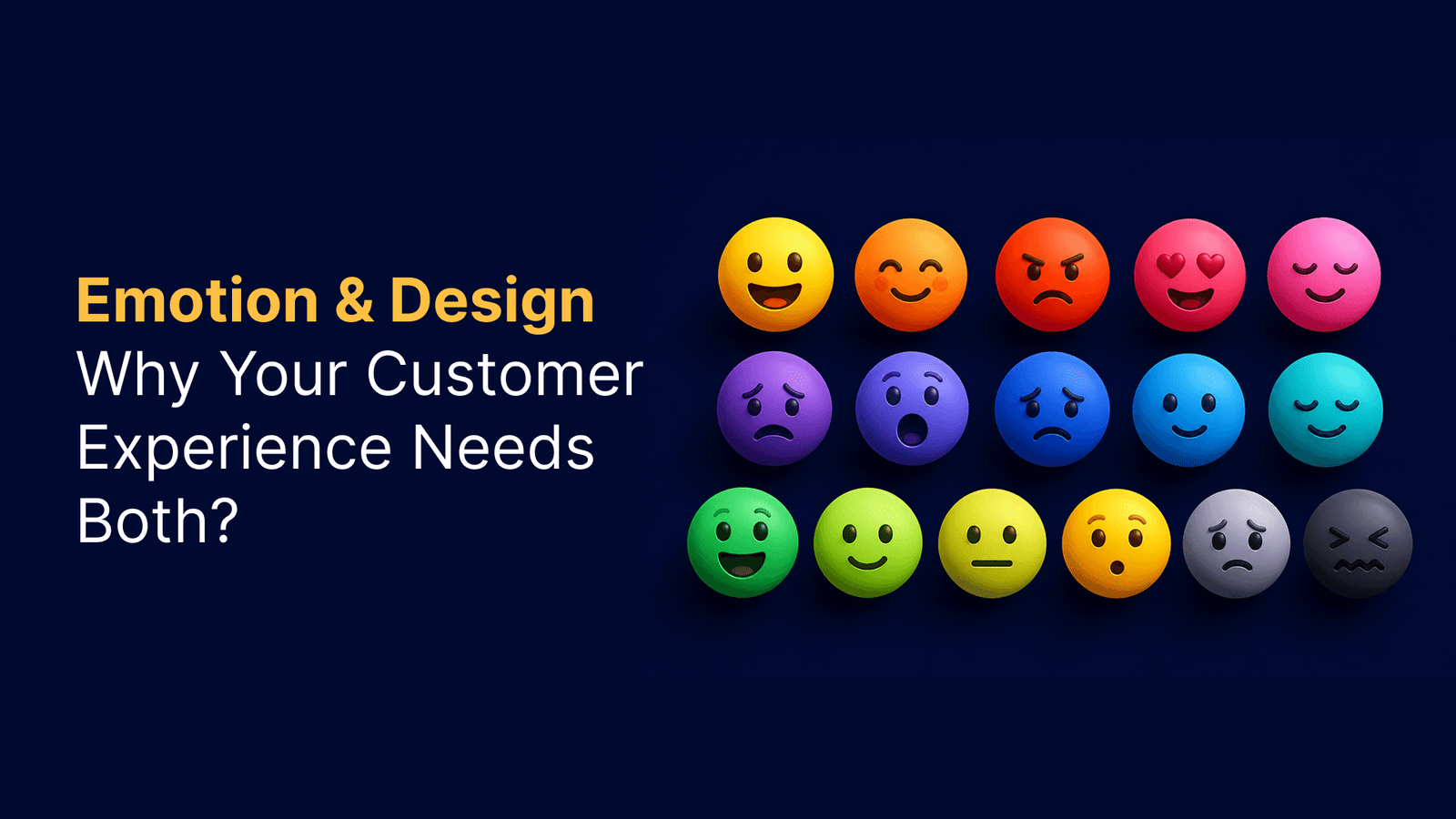

The relationship between emotion and design determines whether customers choose your brand or abandon it. In fact, 74% of customers are likely to buy a product or service based on their experiences with the brand. Emotionally connected customers deliver 25% to 100% greater value in terms of revenue and profitability compared to those who are merely highly satisfied. Emotional design isn’t just about esthetics or usability. It’s about creating experiences that strike a chord on a deeper level and improve measurable business outcomes.
Why emotions drive customer experience decisions?
How the brain processes emotional vs rational information?
Your customer’s brain makes decisions faster than you think. Research using fMRI technology reveals that emotional responses in the limbic system activate an average of 3 seconds before areas associated with rational thinking. This finding challenges the traditional view of the rational consumer who weighs options with care.
Harvard Business School professor Gerald Zaltman found that there was 95% of purchasing decisions take place in the subconscious mind. We buy based on how we feel and justify those decisions with logic afterward. This explains why traditional market research often misses the mark. People lack awareness of emotional and attentional processes, so their verbalized opinions leave out implicit attitudes and fail to reflect authentic product appraisal.
Neuroscientist Antonio Damasio studied individuals with damage to the part of their brain that processes emotions. These people maintained their intelligence and logical abilities but struggled with making even simple decisions. Without emotional cues, they couldn’t assign value to different options. The conclusion is straightforward: no emotion, no decision.
The brain operates through two distinct systems. System 1 thinking is automatic, fast, effortless and emotional. System 2 is controlled, slower and analytical. Automatic emotional evaluation becomes the main determinant of many decisions when ambiguity is high and cognitive load increases. Emotions provide rapid heuristics that help us find solutions to decision-making problems without becoming overwhelmed.
The cost of ignoring customer emotions
Gabriel Udo, a software engineer and founder, illustrates a critical problem: Sarah’s been a customer for five years and has been fighting a billing issue for three days. Michael messages about the enterprise plan, excited about what he sees. Both messages go to the same queue. Sarah gets angrier waiting. Michael loses interest. Sarah cancels and leaves bad reviews by day’s end. Michael buys from a competitor.
This scenario plays out thousands of times daily, and the financial damage is staggering. Research shows that 96% of customers will leave you for bad customer service. Yet most companies treat every customer the same and ignore the emotional context of each interaction.
The numbers tell a stark story. Keeping just 5% more customers can increase profits by 25% to 95%. Customers who are connected emotionally are worth 306% more and stay 5.1 years instead of 3.4. They’re also 52% more valuable to brands than highly satisfied customers, six times more likely to forgive mistakes and four times more likely to try new offerings.
One in three customers will walk away from a brand they love after just one bad experience. The damage extends beyond lost sales. Dissatisfied customers tell 10 to 12 people about their experience, while satisfied customers tell only 3 to 5. Those numbers multiply with social media. People share emotional stories, not technical details.
The disconnect affects employees too. Customer-facing staff trained to follow scripts rather than engage authentically experience higher rates of burnout, absenteeism and turnover.
What customers actually remember from their experiences?
Our memory doesn’t work like a video recorder that captures every moment. The peak-end rule, introduced by Nobel Prize winner Daniel Kahneman, reveals that we judge an experience based on how we felt at its peak and its end, not the average of every moment. The brain remembers the peak and the end of an experience, especially the feelings we had in those moments. The sum of those two moments marks our memories. The rest we forget.
Neuroscience research shows that emotional experiences are stored more deeply than rational information. Multi-sensory marketing messages create stronger neural connections, and memories are not just stored but tagged emotionally. Experiences linked with strong emotions are more easily recalled.
This explains why customers don’t remember your policies. They remember how you made them feel. An event that ends with an improving trend is more likely to result in a positive memory, even if the experience before it was bad. If the most prevalent feeling after an experience is negative, it marks the whole experience, even if it was quite good overall.
The three levels of emotional design
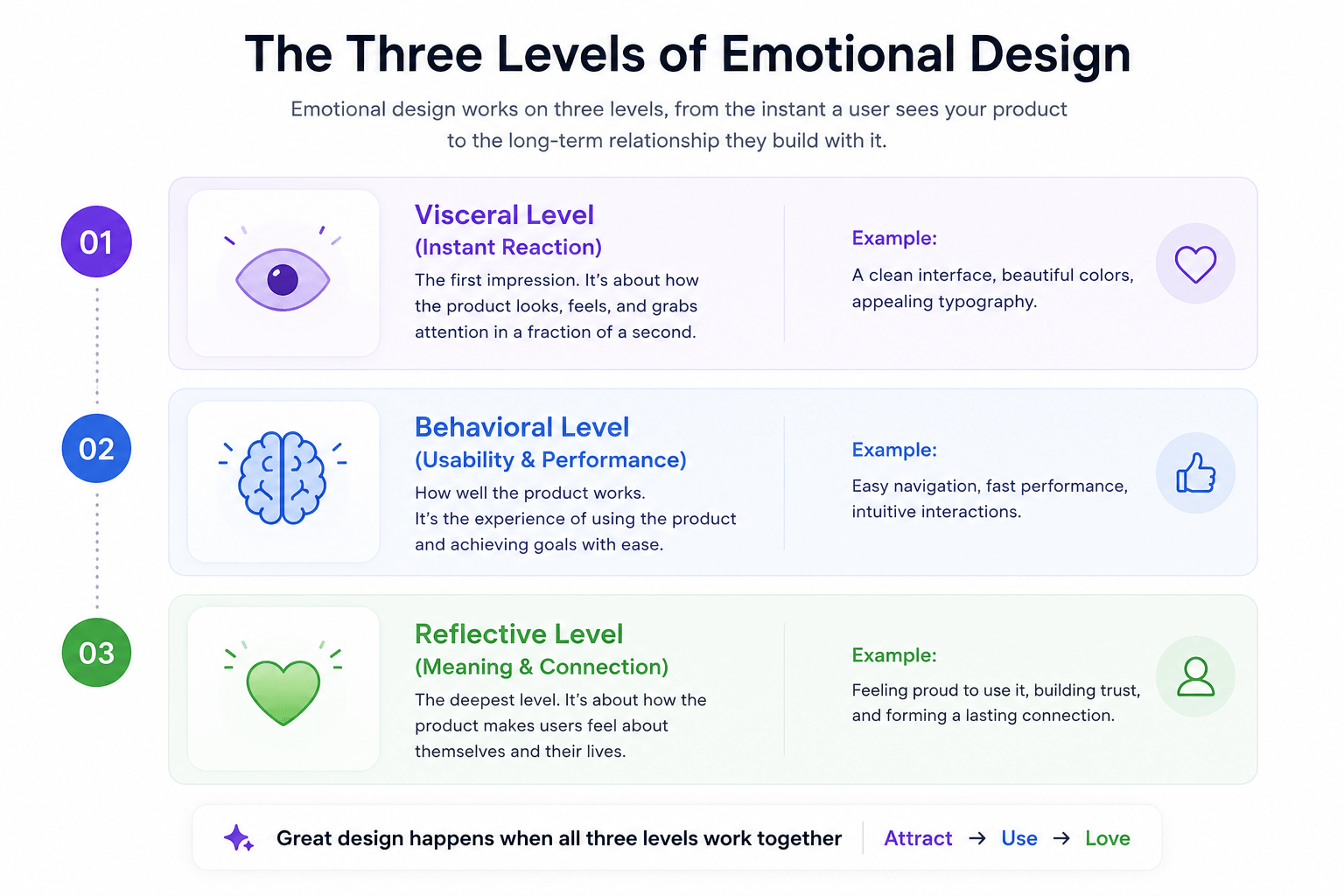
Don Norman, a prominent figure known as the father of UX, created a framework that addresses how emotional design operates on three distinct cognitive levels. Each level targets a different aspect of how users process and connect with products emotionally.
Visceral design: first impressions matter
Users form opinions about your website in just 50 milliseconds. That’s faster than a blink. These snap judgments affect perceptions of esthetics and usability before anyone reads a word or clicks a button.
Visceral design captures the immediate reaction to visual appearance and sensory elements. Colors, typography and imagery all trigger gut-level responses. A modern interface with soft colors and playful images conveys calmness and sets the tone for everything that follows.
First impressions rely on System 1 processing. Users scan for relevant information and interact with items that have high information scent. Esthetically pleasing designs benefit from the halo effect. Users tend to be more forgiving of beautiful designs and remember them as more usable than they were.
Pinterest demonstrates visceral design in action. Every image, board layout and subtle animation creates an experience that feels like flipping through a curated magazine rather than browsing a website. This visual appeal makes users want to stay and explore.
Behavioral design: usability meets emotion
The behavioral level focuses on how products function during actual use. Usability and performance influence emotional responses. When users accomplish their goals with ease, they feel competent and secure.
Pragmatic attributes fulfill functional needs, but hedonic attributes fulfill psychological needs related to emotion and pleasure. Research shows hedonic quality has a stronger relationship to positive affect than pragmatic quality.
Duolingo exemplifies behavioral design. Gamified progress tracking, cheerful sounds and animations when completing lessons make learning fun and rewarding. Users feel accomplished with each small step and build confidence and motivation to return.
A mobile banking app that makes frictionless one-tap bill payment easier and provides immediate alerts creates confidence and eases user anxiety. Clear communication and accessible design help users understand how to interact with the product and enhance their overall experience.
Reflective design: building lasting connections
Reflective design extends beyond immediate interactions to address what products mean to users. This level involves conscious thought and interpretation about a product’s effect on life and identity.
When users relate a design to their values or memories, it forms deep emotional connections. Reflective design creates bonds by making users feel the product is an essential part of their lives. This level influences brand loyalty and advocacy.
Headspace connects with users on a reflective level by encouraging mindfulness and personal growth. The app doesn’t just help users meditate. It helps them feel like they’re investing in their well-being. Users feel good because the product arranges with their values and contributes to their sense of self-improvement.
Effective emotional design engages all three levels. When designs address visceral appeal, behavioral usability and reflective meaning, users develop comprehensive positive associations that transform functional interactions into meaningful experiences.
How design elements trigger emotional responses?
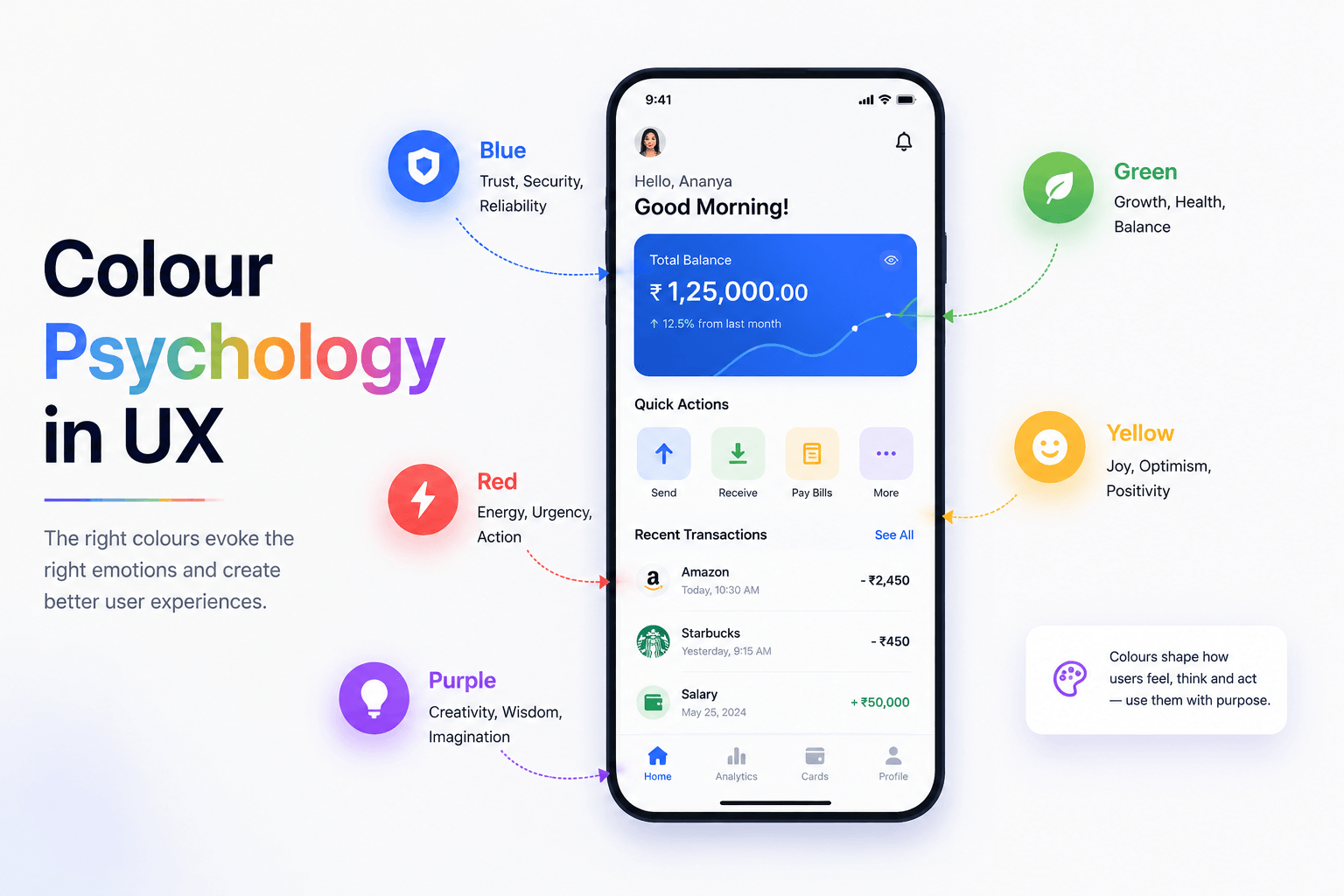
Every visual choice you make sends an emotional signal to your customers. You can transform intuition into strategy once you understand how specific design elements trigger these responses.
Color psychology in customer touchpoints
Colors shape decisions before conscious thought kicks in. Research confirms that 90% of instantaneous consumer decisions are based on colors, while color increases brand recognition by 80%. 62-90% of customer assessment is based solely on color when they interact with your brand.
Different colors evoke distinct emotional responses that influence brand perception. Blue triggers associations with trust (74% of participants) and competence (68%). Red evokes excitement (71%) and energy (76%). Green was associated with health (82%) and environmental responsibility (88%). Red signals danger or urgency but can also feel exciting and powerful, while green inspires calmness and freshness.
Typography and tone of voice
Font psychology affects the thoughts, feelings, and behaviors of those viewing your design in the subconscious mind. Different fonts stir up different emotions and associations, so pick a font that matches your intended tone.
Emotional responses to typography vary across cultures. Monotype’s neuroscience research across eight countries found that sans serif fonts conveyed trust in seven countries surveyed, while Cotford (a serif typeface) performed best for trust in Germany. Font choices and emotional associations varied by language and language family.
Visual hierarchy and cognitive load
Cognitive load predicts whether people complete tasks or abandon them halfway through. Lower the load and you get higher completion rates, fewer support tickets, and users who trust your product.
Good hierarchy means your eye lands on the primary action right away, not after scanning past a dozen other elements. Make your primary CTA big, bold, and a color that doesn’t show up anywhere else on the page. Put your save button in the top right on one screen and the bottom left on the next, and users will pause, scan the entire interface, then move their cursor to the new location slowly. Every inconsistency creates a tiny moment of confusion that adds up to people leaving. Familiar beats clever.
Micro-interactions and delight moments
Micro-interactions are small animations and transitions that make experiences enjoyable, leaving users satisfied and even surprised. These subtle elements provide instant feedback, whether appreciating the user or informing them of problems, which helps guide users and reduce confusion.
Users perform an action and receive immediate, satisfying feedback. This triggers a dopamine release in the brain and creates a sense of accomplishment. Research indicates micro-interactions can increase user engagement by up to 40%. They encourage engagement, display system status, provide error prevention, and communicate brand. Routine tasks transform into moments of delight.
Building your emotional design framework
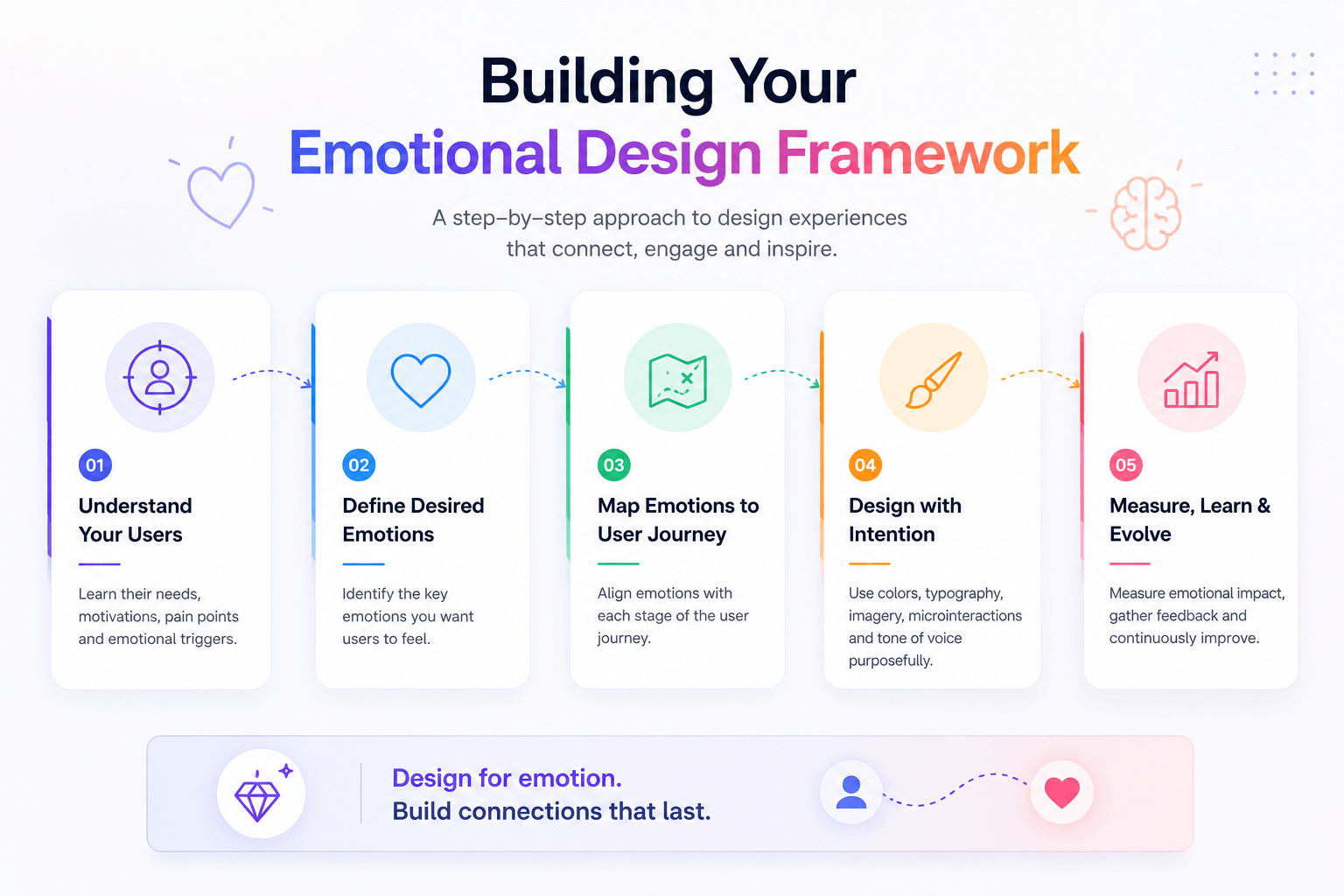
Understanding where you stand is the first step to build an emotional design framework. Map every customer interaction point and document the feelings customers experience at each stage. Look for emotional cues in feedback, surveys, and social interactions to reveal what customers actually feel beyond surface-level actions.
Mapping your current emotional signature
List every touchpoint first, both digital and physical, from website visits to product delivery. Distinguish which moments are purely functional and which have potential to create strong feelings at each interaction. Identify emotional highs and lows to see where excitement builds, where trust is tested, and where frustration sets in.
Identifying critical moments in the customer journey
Pinpoint moments of truth where customers reevaluate their relationship with your brand. First impressions matter when customers first encounter your product. Crisis moments have disproportionate impact on long-term relationships. The end is not always the absolute final interaction but occurs at multiple points, such as order confirmation or issue resolution.
Designing for peak-end experiences
Condense negative emotions at the beginning. Get unpleasant actions out of the way early. Spread positive emotions throughout. Check in and offer pleasant surprises. End on a high note with rewards, discounts, or esthetically pleasing unpackaging experiences.
Creating consistency across all touchpoints
Establish clear brand guidelines that capture your desired perception. Create unified messaging across websites, social media, and physical locations. Integrate backend systems so customer data flows naturally between channels. Give frontline teams the ability to deliver consistent experiences. Document core behaviors and provide autonomy.
Measuring the impact of emotion-driven design
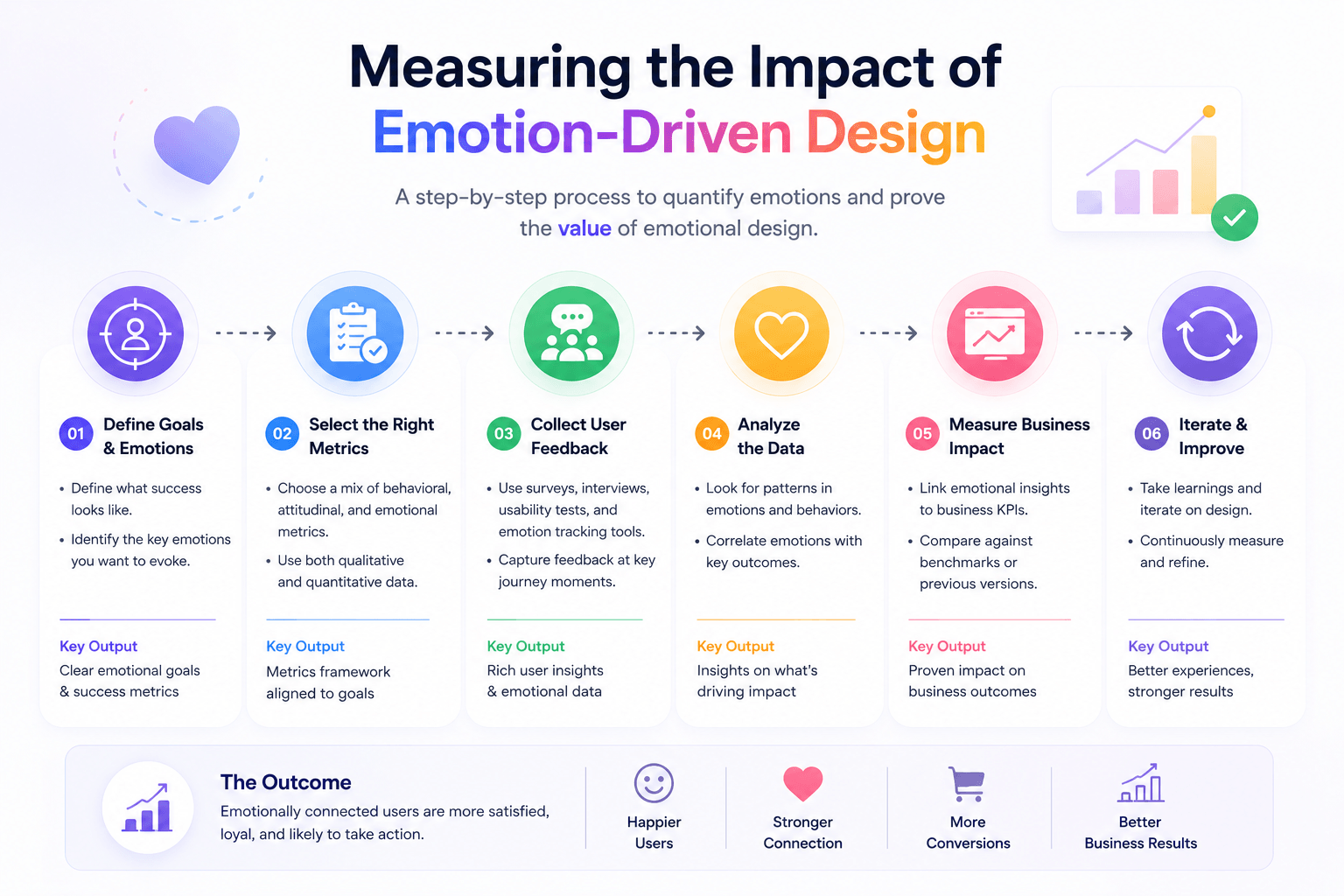
Organizations that treat emotion as a soft metric miss the strongest driver of both customer loyalty and financial performance. The difference between intuition and evidence comes from measuring emotion’s effect.
Quantitative metrics that reveal emotional engagement
Emotionally connected customers are 5.7x more likely to trust the brand. High emotion ratings associate with a 4.6x increase in forgiveness and generate an NPS of 73 versus just 7 for low ratings, an 11.1x multiplier. You should track Net Promoter Score, Customer Satisfaction Score, and the Emotional Value Index (EVI), which categorizes sentiments based on intensity. Behavioral metrics measure dwell time, repeat interactions, and opt-ins. Biometric tools like heart rate variability, facial recognition, galvanic skin response, and eye tracking capture subconscious reactions.
Qualitative research methods for deeper understanding
Have one-on-one conversations and ask questions differently. Avoid direct queries about emotions. Sit among consumers and observe behaviors to practice ethnography. Social listening tools help you find places where customers discuss your brand. The emotional intelligence of the researcher matters. Self-awareness and empathy determine data quality.
Tracking emotional ROI and business outcomes
Emotion leaders outperformed their industries by 10 percentage points while laggards fell 26 points behind over four years. Define emotional outcomes and choose measurable proxies. Collect baseline data, then link emotions to behavior. Calculate reduced churn, lower turnover, and higher reorders to convert behavioral changes into dollar values.
Conclusion
Emotional design separates brands customers remember from those they forget. You create experiences that improve measurable results once you understand how visceral appeal, behavioral usability and reflective meaning work together. The data speaks clearly: emotionally connected customers deliver up to 100% greater value and stay 50% longer.
Map your current emotional signature first. Identify peak moments and pain points at every touchpoint. Focus on the experiences customers will remember, not just the features they’ll use. Measure both emotional engagement and financial outcomes to prove your effect.
Customers won’t remember your policies or features. They’ll remember how you made them feel.
Key Takeaways
Understanding the powerful connection between emotion and design is essential for creating customer experiences that drive loyalty and business growth.
• Emotions drive 95% of purchasing decisions – customers buy based on feelings first, then justify with logic afterward • First impressions form in 50 milliseconds – visceral design elements like color and typography trigger instant emotional responses • Peak-end rule determines memory – customers judge entire experiences based on the most intense moment and how it ends • Emotionally connected customers deliver 25-100% greater value and stay 50% longer than merely satisfied ones • Measure emotional ROI through behavioral metrics – track NPS, dwell time, and repeat interactions to prove design impact
The most successful brands don’t just solve functional problems—they create meaningful emotional connections that transform one-time buyers into lifelong advocates. When you design for how customers feel, not just what they need, you build experiences worth remembering and sharing.
FAQs
Q1. What does emotional design mean in customer experience?
Emotional design refers to creating experiences that evoke specific feelings and connect with users on three cognitive levels: visceral (immediate visual appeal), behavioral (usability and functionality), and reflective (personal meaning and values). This approach helps build positive associations with products and brands that go beyond basic functionality.
Q2. How quickly do customers form first impressions of a design?
Customers form opinions about a website or product in just 50 milliseconds—faster than the blink of an eye. These instant judgments affect their perceptions of esthetics, usability, and credibility before they even read content or interact with features.
Q3. What is the peak-end rule and why does it matter for customer experience?
The peak-end rule, introduced by Nobel Prize winner Daniel Kahneman, shows that people judge an experience based on how they felt at its most intense moment (the peak) and at its conclusion (the end), rather than the average of every moment. This means customers remember the emotional highlights and final impressions more than the overall journey.
Q4. How much more valuable are emotionally connected customers compared to satisfied ones?
Emotionally connected customers deliver 25% to 100% greater value in terms of revenue and profitability compared to those who are merely highly satisfied. They’re also 52% more valuable to brands, stay 5.1 years instead of 3.4 years, and are six times more likely to forgive mistakes.
Q5. How can businesses measure the impact of emotion-driven design?
Businesses can measure emotional design impact through quantitative metrics like Net Promoter Score (NPS), Customer Satisfaction Score, and the Emotional Value Index, as well as behavioral metrics such as dwell time, repeat interactions, and opt-in rates. Qualitative methods include one-on-one interviews, ethnographic observation, and social listening to understand deeper emotional responses.