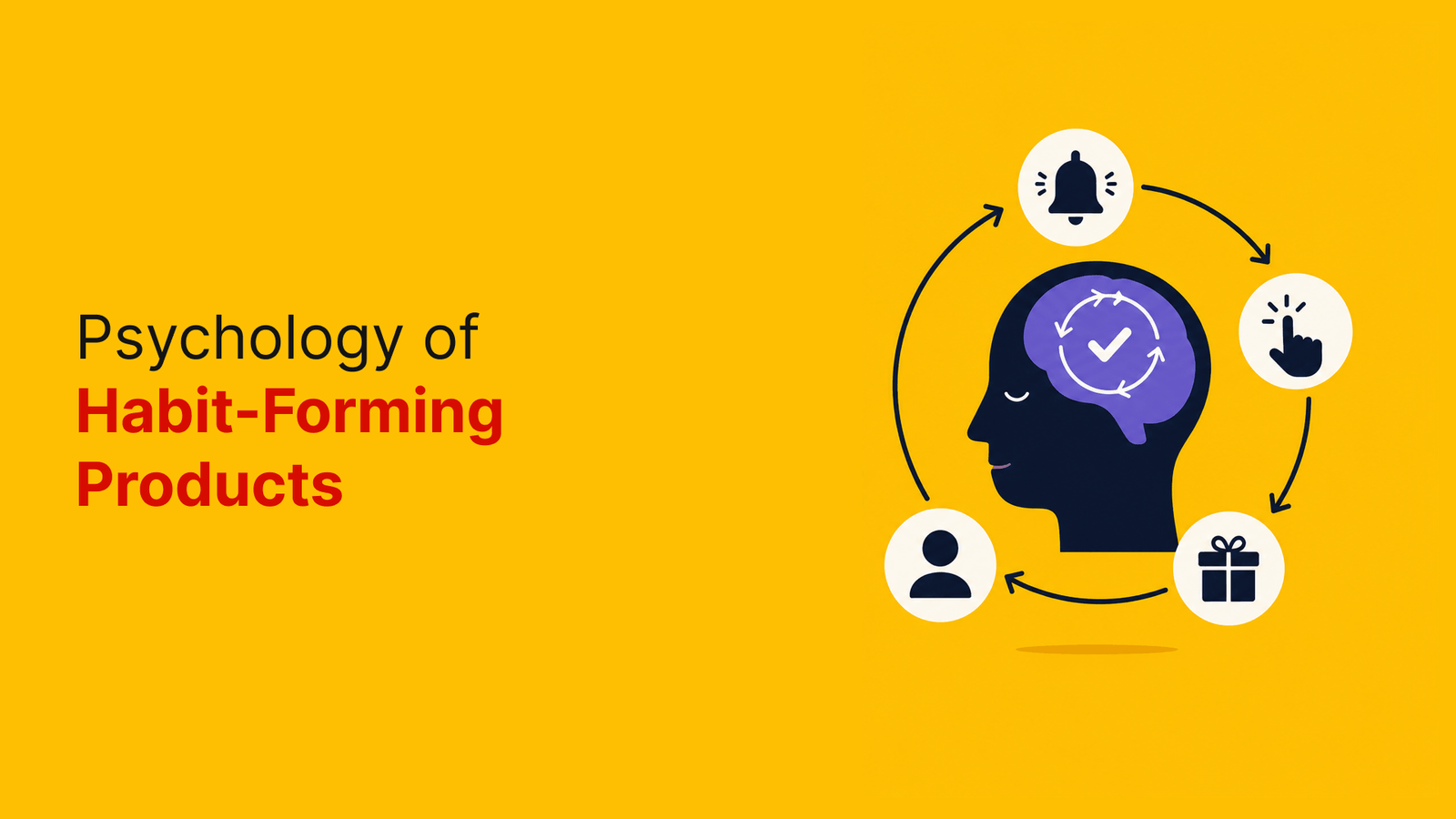

Habit forming products can generate millions of daily users, but building them ethically requires understanding psychology, not manipulation. As a matter of fact, when products successfully associate themselves with users’ emotional needs, they bypass the need for constant external prompts. The challenge lies in creating value-driven experiences that users genuinely want to return to.
In this guide, I’ll explore how to build habit forming products using the Hooked Model, examine habit-forming products examples from leading companies, and show you how to create habit forming products that design habit loops responsibly while balancing business goals with user wellbeing.
Understanding the Psychology Behind Habit Formation
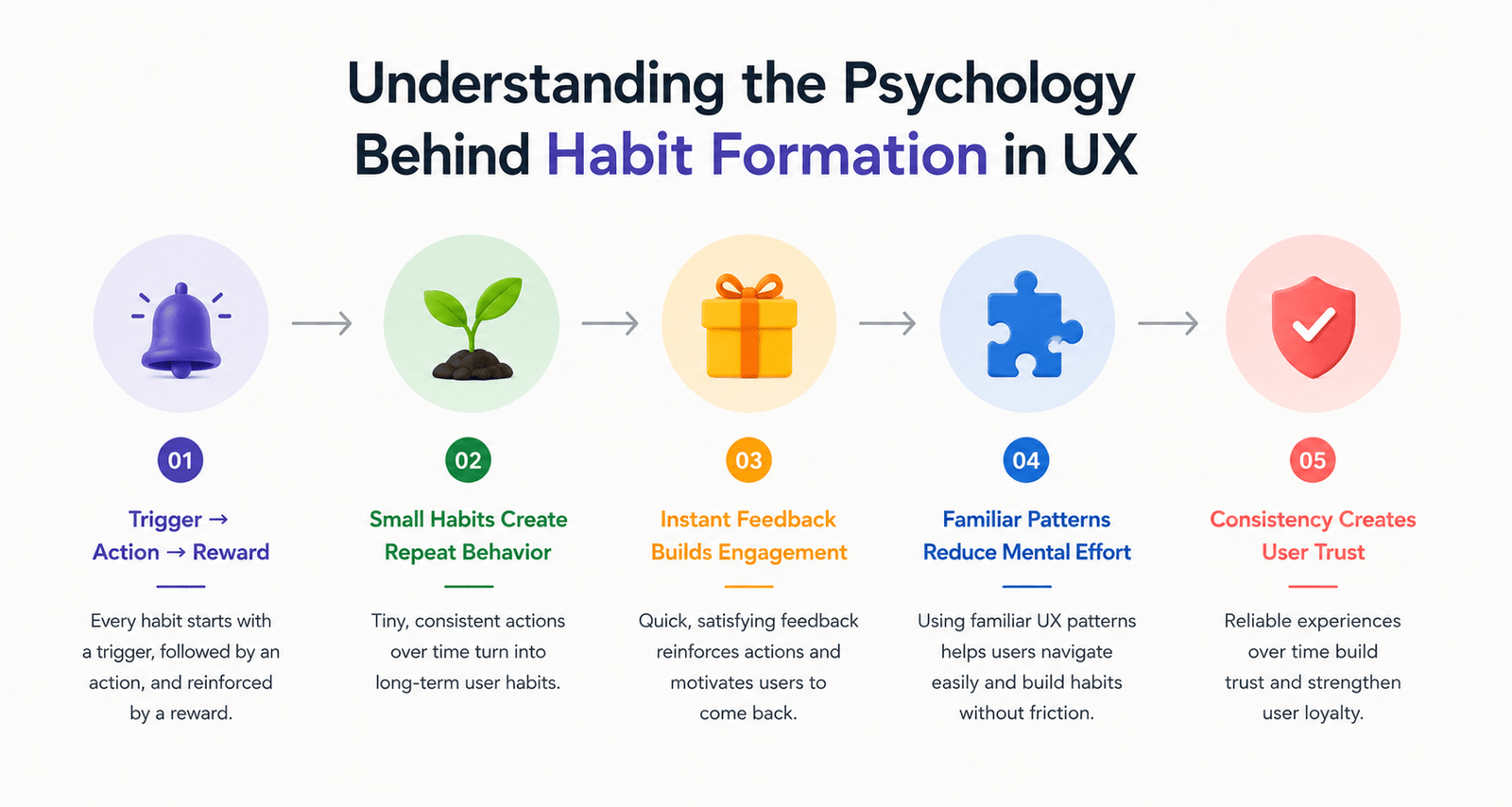
Habits develop through cognitive, motivational, and neurobiological mechanisms that product designers can harness ethically. Psychological theory around habit formation generates recommendations for simple and sustainable behavior change. To build habit forming products, you need to understand three fundamental elements: triggers that initiate action, rewards that reinforce behavior, and investments that deepen commitment.
The role of triggers in habit creation
Triggers serve as cues that start the behavioral loop. External triggers include notifications, emails, and home-screen icons, while internal triggers are emotions, routines, or contexts that associate the product with a felt need. The distinction matters because products that rely solely on external prompts never achieve true stickiness.
BJ Fogg’s Behavior Model reveals that a trigger only works when motivation and ability are present simultaneously. Without those elements, the cue fails to produce action. Fitbit demonstrates this principle through gentle wrist vibrations and step notifications that cue users to check their activity. Over time, these external prompts link with internal triggers like guilt after sitting too long or motivation during a walk.
Triggers fall into five primary categories: time, location, preceding events, emotional state, and surrounding people. Time-based cues create morning routines where waking up triggers a cascade of habits. Location proves particularly powerful as an environment driver of behavior, with research showing new habits are easier to perform in new locations. Emotional states like boredom or uncertainty often trigger product use, as when people Google information when feeling uncertain or check social media when lonely.
Strong habits become tied to contexts and are activated automatically by context cues with minimal influence of goals. When participants move to new locations without cues to habit performance, their goals begin driving actions again, but in stable contexts, habits persist regardless of motivational factors.
How rewards drive repeated behavior?
Variable rewards ground themselves in operant conditioning, where unpredictable reinforcement schedules generate high, persistent rates of responding. Skinner’s work on reinforcement schedules shows that partial, variable rewards produce stronger habit persistence than constant rewards. At a neural level, dopamine signals a reward prediction error. The greater the positive surprise, the larger the dopamine response and the stronger the learning signal.
Instagram’s feed delivers unpredictable, high-value content where the algorithm injects novelty so users experience frequent positive surprises. Duolingo employs variable points, streaks, and daily lesson difficulty that produce small, unpredictable notifications and gratifications. These design patterns work because rewards satisfy cravings that cues trigger. Without rewards, motivation to maintain the habit disappears.
Why investment increases product stickiness?
Investment represents the stage where users contribute time, effort, information, or connections into a product. These contributions make the product more valuable and naturally raise switching costs. When someone builds a playlist, completes their profile, or invites a friend, the experience becomes more personal and rewarding.
Spotify encourages small investments like creating playlists and liking tracks that personalize recommendations and increase return likelihood. Investments load the trigger to bring users back through the hook again. With repeated investments, the product actually gets better with use as users accrue data, content, followers, reputation, or skills.
Product stickiness measures how effectively a digital product engages users and encourages repeated, habitual use. A truly sticky habit forming product must provide enough value that customers return on their own without reliance on push methods. The goal ensures these investments feel easy and worthwhile so users immediately notice benefits in their next interaction.
The Four-Phase Hooked Model Explained
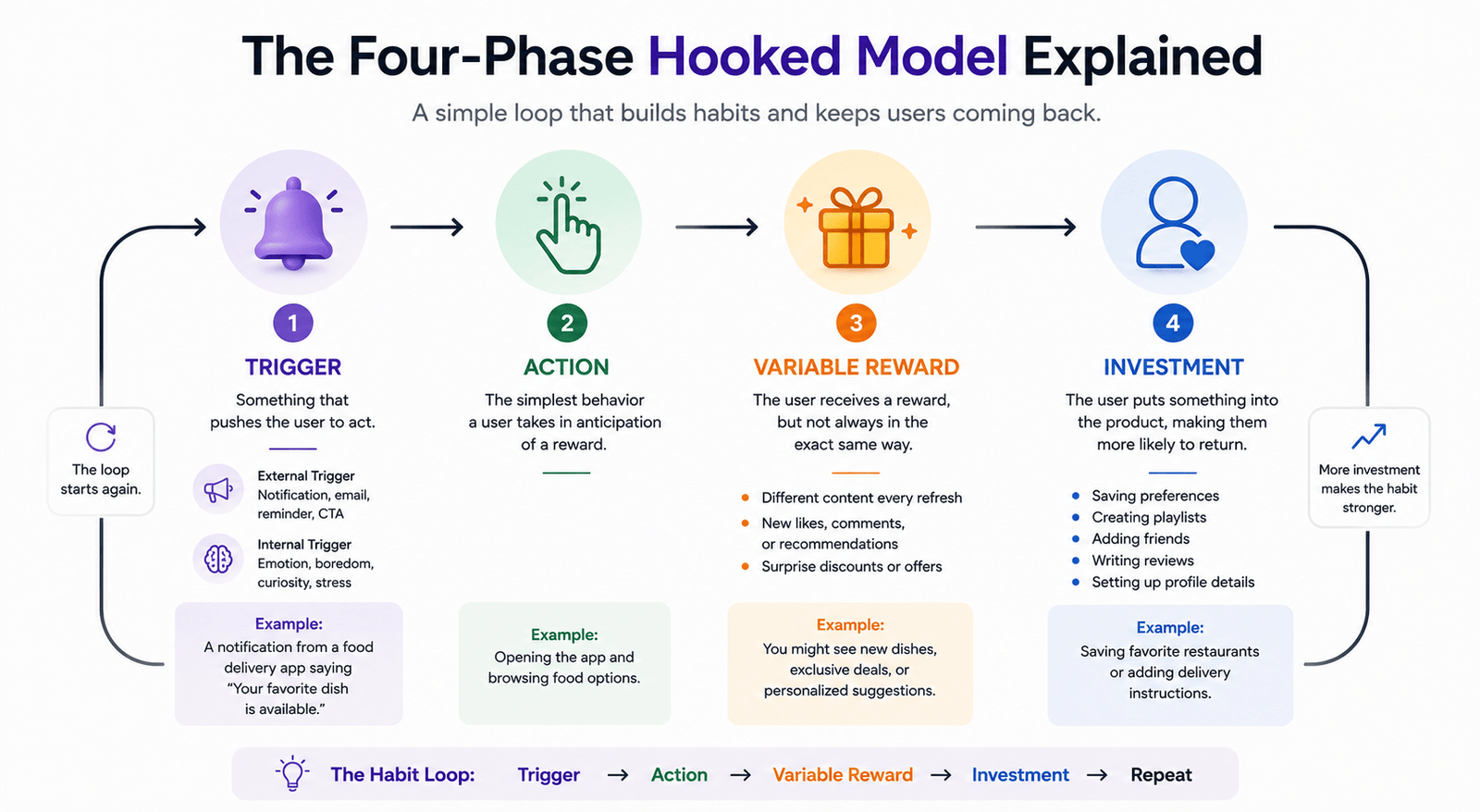
The Hook Model operates as a four-step cycle where each phase builds upon the previous one to create automatic user behavior. This framework moves users from external prompts to internal motivation through repeated loops. Understanding how to build habit forming products requires mastering each phase and recognizing how they interconnect.
Step 1: External and internal triggers
The Hook begins with triggers that prompt user action. External triggers arrive through the environment as notifications, emails, links, or app icons. These initial cues contain information about what users should do next. For instance, Pinterest might appear when someone clicks a wedding-related search image, serving as the external trigger that brings new users to the platform.
Internal triggers emerge once products become associated with thoughts, emotions, or preexisting routines. Loneliness triggers Facebook to provide social connection, boredom prompts finding novel content on YouTube, and lack of purpose drives email checking. The transition from external to internal triggers marks when habit-forming products achieve true stickiness.
Following repeated cycles through the Hook, users form associations between internal triggers and product use. A social media app initially requires notifications as external triggers, but after consistent use, emotions like boredom or loneliness become internal triggers that prompt users to open the app even without notifications.
Step 2: Simplifying the action
Once triggered, users take a specific action in anticipation of reward. This action must be simple and require minimal effort. The action phase draws on Fogg’s Behavior Model, which states that behavior happens when motivation and ability converge with a trigger.
WhatsApp reduces friction to messaging through features like @mentions and slide to reply, making the action of sending a message immediate and habitual. Product designers should measure friction points including time to first meaningful action, number of taps, and cognitive load, then iteratively reduce them. When Barbra clicks on an interesting photo in her Facebook newsfeed, she’s taken to Pinterest with a single action.
Step 3: Variable rewards that keep users engaged
Variable rewards separate the Hook from standard feedback loops by creating wanting in users. The unpredictability taps into the brain’s reward system, making experiences more thrilling. Dopamine surges when the brain expects a reward, and introducing variability multiplies this effect, creating a frenzied hunting state.
Variable rewards come in three types: rewards of the tribe (social validation), rewards of the hunt (information and resources), and rewards of the self (sense of accomplishment). Email demonstrates all three types at random intervals, which explains its habit-forming nature.
When Barbra lands on Pinterest, she sees not only her intended image but also a multitude of other glittering objects associated with her interests. This exciting juxtaposition of relevant and irrelevant content sets her brain’s dopamine system aflutter with the promise of reward.
Step 4: Investment that builds long-term value
The investment phase asks users to contribute time, data, effort, social capital, or money. This phase serves two goals: increasing the odds users will make another pass through the Hook, and improving the service for the next interaction.
Inviting friends, stating preferences, building virtual assets, and learning to use new features are commitments that improve the service. As Barbra scrolls through Pinterest, she builds a desire to keep items that delight her. By collecting, following, pinning, and re-pinning, she gives the site data about her preferences and increases her ties to the platform. These investments prime her for future loops through the Hook.
Habit-Forming Products Examples from Leading Companies
Larry Page applies what he calls “The Toothbrush Test” when evaluating companies. He wants products people will use once or twice daily, understanding that frequently used products form sticky customer habits. This approach reveals why Google owns multiple daily-use properties. By contrast to businesses that rent attention through ads, owning a customer’s habit becomes an asset that pays dividends repeatedly.
How Google became a daily habit?
Google embedded itself into daily routines by solving immediate, recurring problems. Search became the default response to uncertainty. Gmail transformed into a constant checking behavior. The company grasped that habit-forming products don’t require persistent marketing when they address frequent use cases.
Hacker News, owned by Y Combinator, demonstrates content consumption habits perfectly. The site attracted 18.6 million visits in July 2016. Users check between coding sessions or during breaks for industry news. The constantly changing article list creates all the elements necessary for habit formation.
Instagram’s variable reward system
Instagram operates like a digital casino where each notification, like, or follower functions as a mini jackpot. Research from Harvard shows that receiving likes activates the same brain regions as monetary rewards. Scrolling mirrors pulling a slot machine lever. Sometimes you discover a funny meme or sweet comment. Sometimes nothing appears.
This unpredictability employs variable ratio reinforcement, psychology’s most powerful behavior training method. Your brain whispers “maybe this time” which explains checking your phone without needing to. Neuroscientists at Stanford found that excessive social media use rewires reward pathways, increasing sensitivity to digital approval while decreasing response to everyday joys.
Duolingo’s streak investment mechanism
Duolingo transformed streak tracking into an emotional investment vehicle. Over 6 million people maintain streaks of 7 days or more. The feature works differently across streak lengths. New learners experience exciting momentum as their streak grows from 2 to 3 days, representing a 50% increase. Similarly, going from 200 to 201 days equals only 0.5% growth.
Loss aversion kicks in as streaks lengthen. New celebration animations increased the likelihood brand new learners continued using Duolingo 7 days later by 1.7%. Streak Freezes provide flexibility when life interferes. Allowing two freezes simultaneously increased daily active learners by 0.38%. Learners who reach a 7-day streak are 3.6 times more likely to complete their course.
The Line Between Persuasion and Manipulation
Identifying coercive design patterns
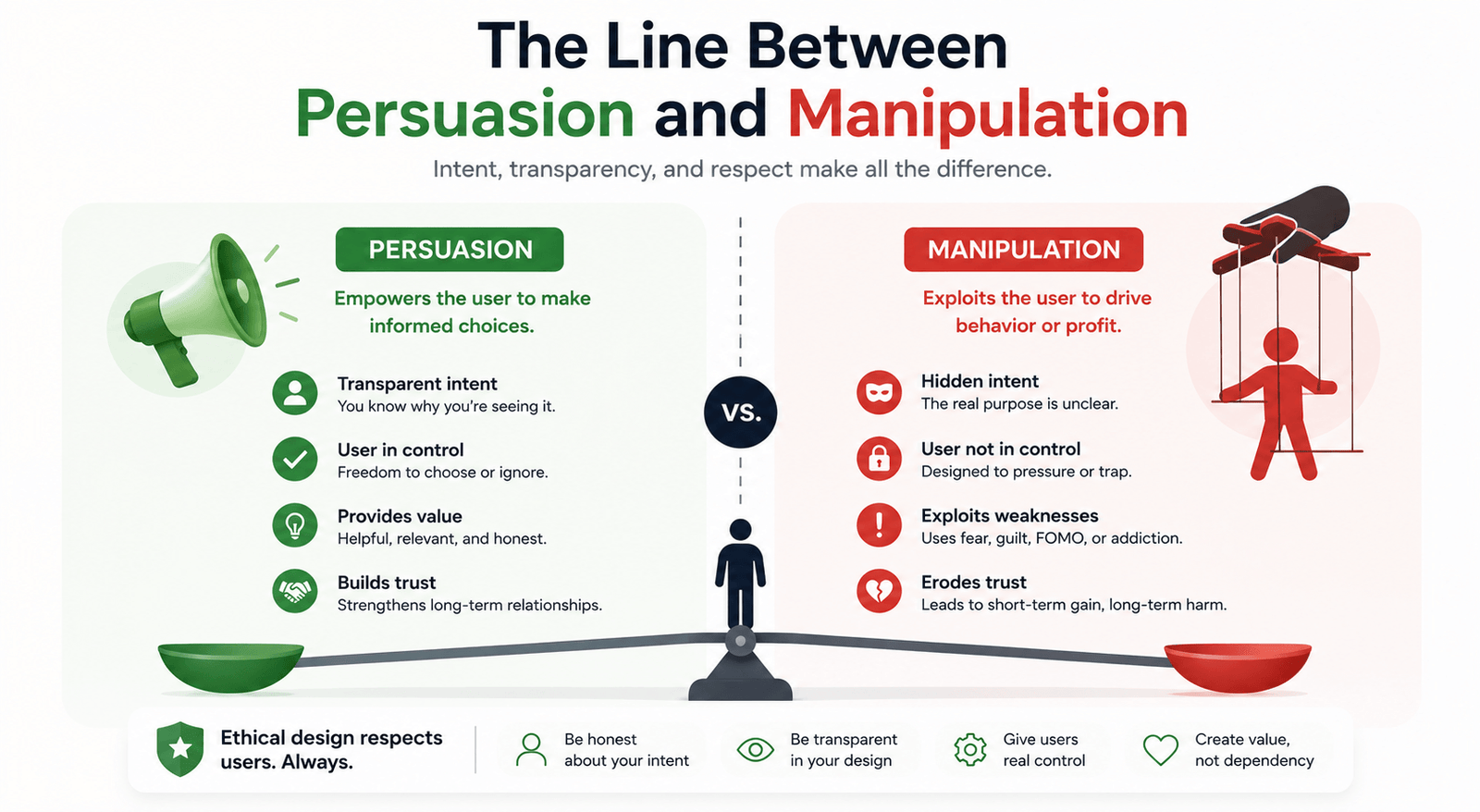
Dark patterns are design tricks that coerce or mislead users into actions they might not otherwise take. These tactics intentionally manipulate users into accepting all cookies, sharing more data than intended, or skipping privacy settings altogether. The manipulation doesn’t happen by accident. Designers create these patterns with a purpose: extracting consent while avoiding the friction of informed refusal.
Common coercive tactics include making it harder to refuse than to accept. A classic example involves hiding the ‘Reject all’ option behind multiple clicks while ‘Accept all’ sits instantly available. Pre-checked consent boxes assume agreement without clear user action. Repeated prompts reappear every time someone declines, wearing down resistance through sheer repetition. Designers also use color, size, and placement strategically. ‘Accept all’ appears as a bright, bold button while ‘Manage settings’ looks like a grayed-out hyperlink buried in fine print.
Building products users want to use
The difference between persuasion and manipulation is intent. Persuasion provides facts and reasons presented in a sufficiently fair and neutral way. Manipulation, essentially, means controlling someone to your own advantage, often unfairly or dishonestly. When you design habit forming products, ask whether you’re treating users as puppets on a string. Almost no one wants to be someone else’s puppet without consent.
The regret test for ethical design
The regret test asks a simple question: if people knew everything you as the product designer know, would they still execute the intended behavior? Would they regret this action? If users would regret taking the action, the technique fails the regret test and shouldn’t be built into the product. Getting people to do something they didn’t want to do is no longer persuasion. It’s coercion. Test potential features by asking representative samples whether they would take an action knowing everything that happens next. Ignoring people who regret using your product is not only bad ethics but also bad for business.
How to Create Habit Forming Products Responsibly
Building responsible habit forming products starts with methodology, not manipulation.
Start with frequent use cases
Products form habits at the intersection of utility and frequency of use. Your app may solve a valuable problem, but if users need it once monthly, habit formation remains unlikely. Focus on problems that recur daily or weekly. According to Nir Eyal’s habit testing framework, identify which users already engage frequently. If at least 5% of your user base qualifies as habitual users, you have a foundation to build on. Below that threshold, reevalaute your core value proposition before optimizing habit loops.
Focus on solving real user problems
Habit design sits on a moral fault line. When products genuinely solve problems, they empower users. When they exploit vulnerabilities like compulsive consumption or attention hijacking, they cause harm. Design hooks that improve users’ lives rather than extract engagement metrics.
Test and refine your habit loops
Codify the specific actions your most loyal users take, then test whether guiding new users down that same path increases retention. Iterate continuously based on real behavior patterns.
Balance business goals with user wellbeing
Long-term trust outweighs short-term engagement. Companies integrating digital wellbeing features recognize that ethical design builds competitive advantage. Dismiss the myth of creating habits in 21 days. Lally et al. tracked real people and found habit formation takes many weeks, following a decelerating curve rather than a fixed threshold.
Conclusion
Habit-forming products represent powerful business assets, but only when built on genuine value rather than manipulation. As a matter of fact, the Hooked Model works best when it solves real problems that users face repeatedly. The distinction between persuasion and coercion determines whether your product builds trust or destroys it.
When you focus on frequent use cases, variable rewards that delight, and investments that genuinely improve the experience, you create products people want to return to. Apply the regret test to every feature. Your most sustainable growth comes from users who feel better for having used your product, not worse.
Key Takeaways
Understanding how to build habit-forming products ethically requires balancing psychological principles with user wellbeing, focusing on genuine value creation rather than manipulative tactics.
• Master the four-phase Hook Model: Use triggers, simplified actions, variable rewards, and user investment to create sustainable engagement loops that solve real problems.
• Apply the regret test for ethical design: Ask if users would still take the action knowing all consequences – if they’d regret it, don’t build it.
• Focus on frequent use cases first: Target problems that occur daily or weekly, ensuring at least 5% of users engage habitually before optimizing loops.
• Distinguish persuasion from manipulation: Build products that empower users to achieve their goals rather than exploit psychological vulnerabilities for engagement metrics.
• Balance variable rewards with genuine value: Use unpredictable reinforcement to maintain interest while ensuring each interaction provides meaningful benefit to the user.
The most successful habit-forming products create genuine value that users appreciate long-term. When you prioritize user wellbeing alongside business goals, you build trust that translates into sustainable competitive advantage and authentic user loyalty.
FAQs
Q1. What psychological mechanisms drive habit formation in products?
Habits develop through cognitive, motivational, and neurobiological mechanisms involving three key elements: triggers that initiate action (like notifications or emotions), rewards that reinforce behavior (especially variable, unpredictable ones), and investments that deepen commitment (such as time, data, or effort contributed by users).
Q2. What is the Hook Model and how does it work?
The Hook Model is a four-step cycle developed by Nir Eyal for creating habit-forming products. It consists of triggers (external or internal cues), actions (simplified behaviors), variable rewards (unpredictable reinforcement), and investment (user contributions that improve future experiences). Each phase builds upon the previous one to create automatic user behavior.
Q3. How long does it actually take to form a habit?
Contrary to the popular 21-day myth, research by Lally et al. shows that habit formation actually takes many weeks and follows a decelerating curve rather than a fixed threshold. The timeline varies significantly based on the complexity of the behavior and individual differences.
Q4. What is the regret test in ethical product design?
The regret test asks whether users would still take an action if they knew everything the product designer knows about the consequences. If users would regret the action after having full information, the feature fails the test and shouldn’t be built, as it crosses the line from persuasion into manipulation.
Q5. What percentage of habitual users indicates a product has habit-forming potential?
According to Nir Eyal’s habit testing framework, if at least 5% of your user base qualifies as habitual users (engaging frequently and consistently), you have a solid foundation to build on. Below that threshold, you should reevaluate your core value proposition before optimizing habit loops.